How to Create Brand Voice Guidelines Your Team Will Actually Follow
TLDR
Most brand voice guidelines fail because they're comprehensive instead of practical. A 60-page document that takes five minutes to find and ten minutes to read isn't a guideline — it's a performance of having done the work. The guidelines that actually get used are short, specific, example-driven, and built for the decisions your team makes repeatedly. They also need to be AI-ready: structured in a way that both humans and AI tools can interpret consistently. This post shows you exactly how to build that.
You've written the brand voice guidelines. Maybe it took weeks. Maybe you hired someone. The document exists, it lives in a shared folder, and it describes your brand's personality in careful detail.
Nobody reads it.
Not because your team doesn't care. Because the guidelines weren't designed for how work actually happens. Designers and copywriters need answers to specific questions in under 30 seconds. "Can I use a more casual tone for this email?" "Would our brand say 'get started' or 'begin your journey'?" "Is this sentence too formal?"
A 60-page brand book requires them to search, find the relevant section, interpret it, and apply it to a context the document may not have covered. Most of the time, they guess instead.
Here's how to build guidelines that actually get used — and that your AI tools can apply reliably.
Why Most Brand Voice Guidelines Fail
Before building the right thing, it's worth understanding exactly why the wrong thing is so common.
They describe aspiration, not behavior. "Warm and authoritative" is an aspiration. "Write sentences under 15 words. Never use exclamation points. Always use active voice" is a behavior. Behavior is what guides decisions. Aspiration is what gets nodded at and ignored.
They use adjectives without examples. "Professional yet approachable" means something different to every person who reads it. The only way to make it concrete is to show it in action. An on-brand sentence next to an off-brand sentence does more work than three paragraphs of description.
They're comprehensive instead of practical. Most brands don't need a 60-page guidelines document. They need answers to the ten questions that come up most often. The best brand guidelines are 15 pages of useful content, not 60 pages of comprehensive content.
They're not AI-ready. Guidelines written before AI became central to content workflows were written for humans. An AI tool can't interpret "approachable and warm" reliably — it needs vocabulary lists, forbidden phrases, structural rules, and calibration examples it can pattern-match against.
The Structure That Actually Works
A brand voice guide that gets used has six sections and nothing more.
Section 1: The One-Sentence Voice Statement
This isn't your mission statement. It's a description of how your brand sounds in one sentence that someone can remember and apply without looking anything up.
Good examples:
"We write like a confident expert who respects the reader's intelligence and doesn't waste their time."
"We sound like a brilliant friend who happens to know everything about marketing — direct, warm, never condescending."
"We write the way a seasoned professional speaks in a meeting: clear, specific, no fluff."
Bad example:
"Our brand voice is professional, approachable, innovative, and human-centered."
The test for your voice statement: can someone who's never worked with your brand read it once and make better decisions about copy without reading anything else? If not, rewrite it.
Section 2: Three Voice Pillars With Examples
Choose three characteristics that define your voice — not aspirational adjectives, but behavioral descriptions. For each one, write one sentence describing the behavior and then show it with a before/after example.
Format:
[Pillar name]: [One sentence behavioral description]
Off-brand: [Example of what NOT to write]
On-brand: [Example of what TO write]
Example set for a bold DTC brand:
Direct: We say what we mean in the fewest words possible. No preamble, no hedging.
Off-brand: "We're thrilled to introduce our latest collection, which we believe represents an exciting step forward in our ongoing commitment to quality."
On-brand: "New collection. Fewer pieces. All built to last."
Example set for a professional services brand:
Authoritative: We state facts with confidence. We don't qualify everything.
Off-brand: "It might be worth considering whether this approach could potentially be beneficial for your situation."
On-brand: "This approach works. Here's why."
Three pillars is the right number. More than three is noise. Fewer than three doesn't give enough to work with.
Section 3: The Vocabulary List
This is the section most guidelines skip — and the most useful one for both humans and AI tools.
Two columns. No more than 20 items per column.
Words and phrases we use:
[Your brand's preferred vocabulary — specific to your voice, not generic]
Words and phrases we never use:
[Generic corporate phrases, competitor language, anything that reads as inauthentic]
The forbidden list is more important than the preferred list. Removing the phrases every brand uses forces writers — and AI tools — to find your language instead.
Universal forbidden phrases (these apply to almost every brand):
Leverage / leverages
Seamlessly
Empower / empowers
Cutting-edge
Innovative solution
In today's fast-paced landscape
World-class
Revolutionary
Game-changing
Unlock your potential
Your brand-specific forbidden list will include additional phrases particular to your category and positioning.
Section 4: Tone by Context
Voice is constant. Tone adapts. Your brand sounds the same, but a product launch announcement has different energy than a customer complaint response.
Document the four or five contexts your team writes in most frequently, and describe how the tone shifts while the voice stays the same.
Example:
Context | Tone | Example opening |
|---|---|---|
Product launch | Confident, direct | "It's here." |
Customer service | Warm, clear | "We've got this. Here's what happens next." |
Error message | Calm, helpful | "Something went wrong. Let's fix it." |
LinkedIn post | Direct, slightly informal | "Most brands are doing this wrong." |
Email subject line | Specific, no fluff | "Your order ships tomorrow" |
This section prevents the most common tonal failure: a brand that sounds great on its website but robotic in its support emails and overly casual in its LinkedIn posts.
Section 5: Three Calibration Examples
These are your most important asset. Find three pieces of existing copy that nail the voice — an email, a social post, a product description. Copy them in verbatim.
These examples serve two purposes:
For humans: They anchor the abstract. When someone reads your voice pillars and then reads these three examples, the combination makes the guidelines concrete in a way that descriptions alone never achieve.
For AI tools: These are your calibration inputs. Any AI-powered rewriting system — including Calibr — uses these examples to pattern-match against your voice when generating or rewriting content. The better these examples, the more accurately the tool produces on-brand output.
Choose examples that are short (under 100 words each), clearly representative of your voice at its best, and diverse in content type — not three versions of the same format.
Section 6: What We Sound Like vs What We Don't
One page. Two columns. Five examples per column.
We sound like this:
[Five on-brand sentences or short passages]
We don't sound like this:
[Five off-brand sentences showing common failure modes]
This section does the most work in the least space. Side-by-side contrast is the fastest way to make voice guidelines actionable.
Making Your Guidelines AI-Ready
In 2026, your brand voice guidelines need to work for AI tools as well as for humans. This requires a specific structural consideration that most guidelines miss.
AI tools interpret guidelines based on what they can pattern-match, not what they can conceptually understand. "Professional yet approachable" requires conceptual interpretation. A vocabulary list, a forbidden phrases list, and three calibration examples require pattern matching.
The sections above are structured specifically to be machine-readable:
The vocabulary list maps directly to include/exclude instructions
The forbidden phrases list maps directly to output filtering
The calibration examples map directly to voice pattern matching
The tone-by-context table maps directly to conditional instructions
If you use Calibr, the voice profile setup is designed around exactly this structure. You paste your calibration examples, your vocabulary preferences populate the profile, and the system builds a structured voice definition that gets applied to every rewrite automatically.
The brands that are getting the most value from AI content tools in 2026 are the ones that did the groundwork of defining their voice properly. Clear tone guidelines, vocabulary lists, and example content can be applied to AI tools consistently — scaling content production without sacrificing the consistency that makes the brand recognizable.
Common Mistakes to Avoid
Don't write guidelines for a brand you wish you were. Write guidelines that reflect how your brand actually sounds at its best. Aspirational guidelines produce a gap between the document and reality — which is why they get ignored.
Don't make them comprehensive. Every section you add is another section that won't get read. Cover only what gets referenced repeatedly: voice statement, pillars with examples, vocabulary lists, tone by context, calibration examples, side-by-side contrast. That's it.
Don't skip the forbidden list. The vocabulary list matters. The forbidden list matters more. Generic phrases are the primary way brand voices drift — removing them explicitly is the fastest way to make output more distinctive.
Don't store them in a place that takes more than 30 seconds to find. Guidelines that live in a PDF in a folder somewhere are guidelines that don't exist. Put them somewhere your team opens every day — the top of a Notion page, a pinned Slack message, a bookmark. Access speed determines usage frequency.
Don't set them and forget them. Review and update once a year, or when you reposition significantly. Guidelines that reference a campaign from two years ago actively damage the brand by teaching people the wrong patterns.
How Long Should Brand Voice Guidelines Be?
The right length is the minimum length that covers what your team needs to make good decisions consistently.
For most brands that means:
Voice statement: 1-2 sentences
Three pillars with examples: 1 page
Vocabulary list: 1 page
Tone by context: 1 page
Calibration examples: 1 page
Side-by-side contrast: 1 page
Six pages. Maybe eight. Not 60.
The goal is guidelines someone will open, reference, and apply in under a minute — not a document that demonstrates how thoroughly you've thought about your brand.
Turning Guidelines Into Results
Well-built brand voice guidelines solve the document problem. But documents only go so far.
The real challenge is application at scale — making sure the guidelines are actually used every time someone writes copy, not just when they remember to check. This is where most brands still struggle, even with excellent guidelines.
The gap between having guidelines and consistently applying them is where brand voice drift happens. A new team member interprets the pillars differently. An AI tool generates from scratch without the context. A freelancer doesn't have access to the calibration examples.
The most effective approach in 2026 is to make the guidelines operational — meaning they're applied automatically, not consulted manually. That means building them into your AI workflow as a persistent voice profile rather than a document that requires human lookup.
Calibr is built for exactly this. You build your voice profile once — using the calibration examples and vocabulary preferences from your guidelines — and every rewrite you run through Calibr applies that profile automatically. The guidelines stop being a document people might read and become a system that works whether people remember to check or not.
Build your first voice profile in Calibr — free, no credit card required →
SOUND LIKE YOURSELF. EVERY TIME.
Calibr rewrites any text to match your saved brand voice in seconds.
★★★★★ No credit card required
Benefits
Everything your brand voice needs
Instant rewrite
Under 10 seconds from paste to calibrated output
Precise voice matching
Trained on your actual copy, not generic prompts
Multiple profiles
Separate voice for every client or brand
Rewrite history
Every calibration saved and accessible
Regenerate
Not happy with the output? One click to try again
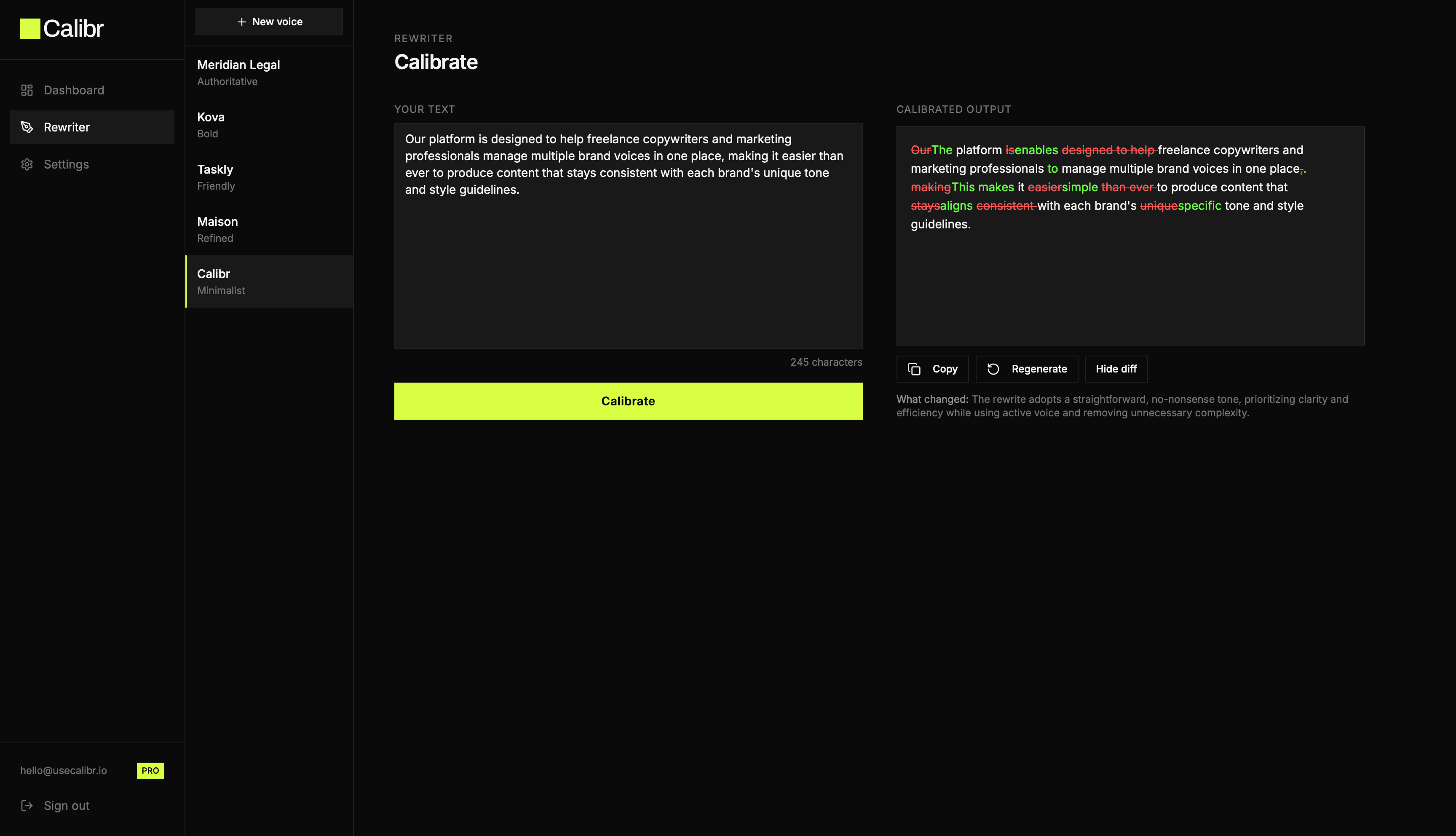
What changed
Plain English summary of every adjustment made
A Note on Agencies and Multiple Brands
If you're an agency or a freelancer managing multiple clients, the framework above applies per brand — not as a single guide that tries to cover all clients.
Each brand gets its own voice statement, its own pillars, its own vocabulary list, its own calibration examples. The structure is the same. The content is different. This is exactly what makes client work hard to do at scale with AI: every brand needs its own persistent context, not a shared prompt that tries to accommodate everyone.
When you have five clients with five distinct voices, you need five profiles — not one set of guidelines with five rows in a table.
How it works
How Calibr works
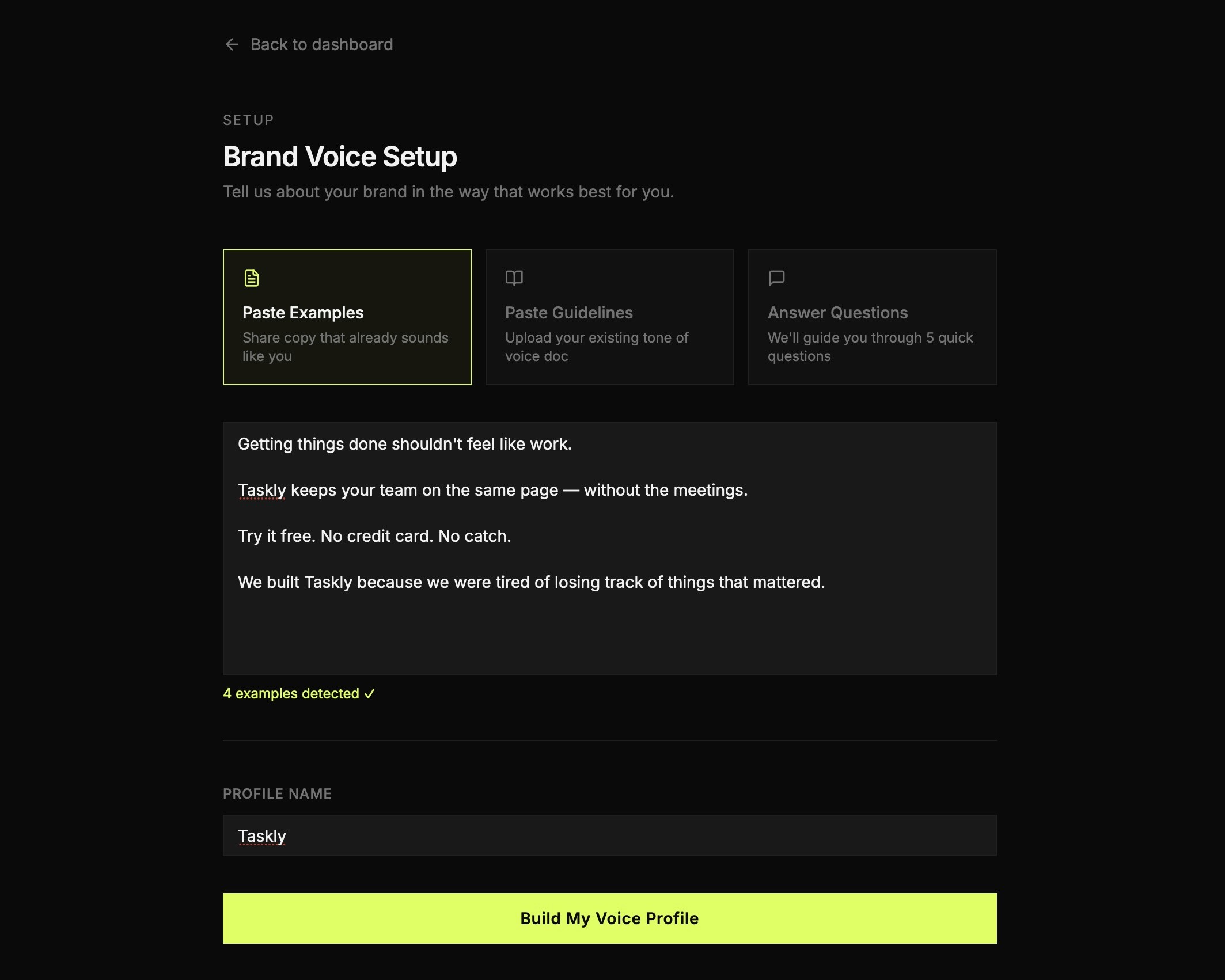
Step 1
Build your voice
Paste examples, upload guidelines, or answer five questions. Done in minutes.
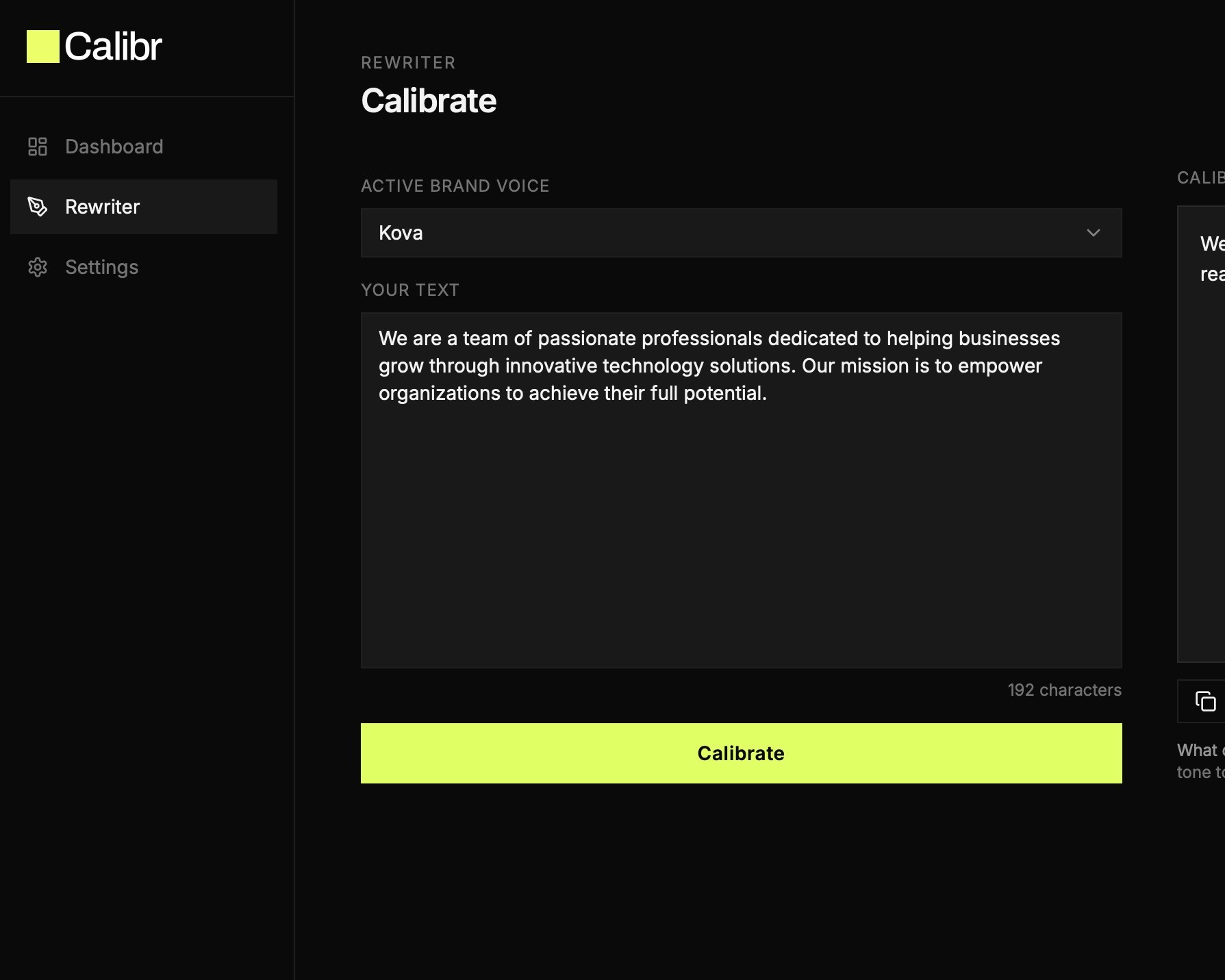
Step 2
Paste any text
AI output, a draft, vendor copy, anything that needs to sound like your brand.
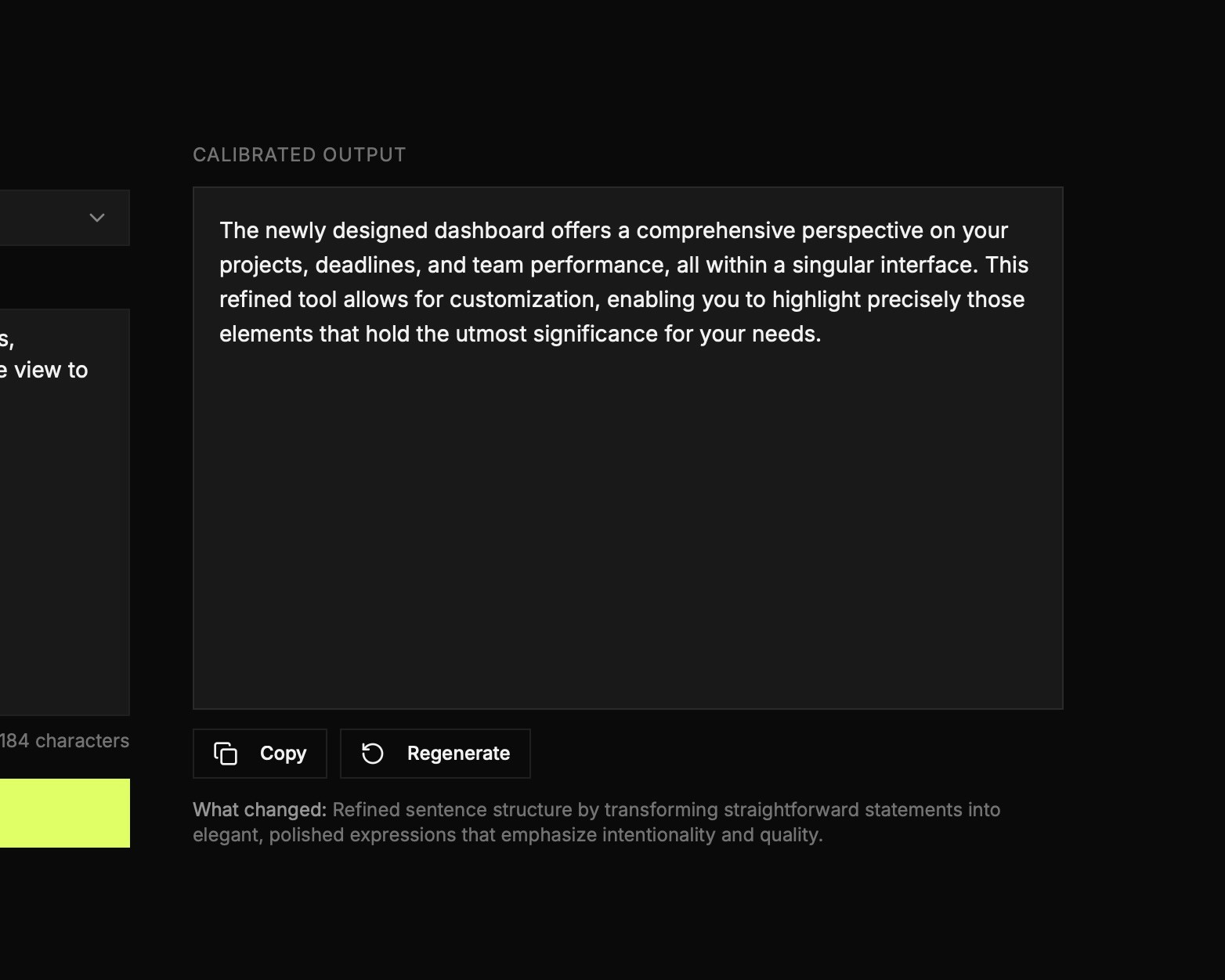
Step 3
Get calibrated copy
Your text, rewritten in your voice. Copy it and ship it.
Frequently Asked Questions (FAQ)
How long should brand voice guidelines be?
6-8 pages for most brands. The goal is minimum useful length — enough to answer the decisions that come up repeatedly, nothing more. Long guidelines are guidelines that don't get used.
What's the difference between brand voice and brand tone?
Voice is constant — it's your brand's personality, which never changes. Tone adapts to context — the same brand sounds different in a product launch than in a customer complaint response. Your guidelines need to document both: the stable voice and the contextual tone variations.
How do I get my team to actually follow the guidelines?
Three things: make them short, make them specific, make them easy to find. Behavioral descriptions with examples beat abstract adjectives. A shared Notion page beats a PDF in a folder. Review them in onboarding for every new team member and external collaborator.
How do I make brand voice guidelines work with AI tools?
Structure them for machine-readable interpretation: vocabulary lists, forbidden phrases, and calibration examples rather than purely descriptive language. These formats map directly to what AI tools can use for pattern matching. A tool like Calibr uses this structure directly to apply your voice profile to every rewrite.
How often should I update brand voice guidelines?
Annually, or when you go through a significant repositioning or rebrand. More frequent updates create confusion. Less frequent updates allow drift. Once a year is the right cadence for most brands.