How to Onboard a New Client's Brand Voice in Under an Hour
TLDR
You do not need a two-week brand voice workshop to start writing for a new client. You need a 7-question intake call, three sample documents, a one-page brand voice doc, and a quick test. Here is the exact process — under an hour, repeatable, and reliable enough that you can charge for it.
A new client signs on Monday. Their first deliverable is due Friday. They have no brand book, no style guide, and a vague answer when you ask about voice.
This is the most common starting point for freelance copywriters and small agencies, and it is also the moment most of them lose the most time. Two days of email back-and-forth, a fuzzy brand voice doc nobody references again, and a first draft that comes back covered in tracked changes because it "doesn't sound like us."
You can do better than this in under an hour, every time, with a repeatable process. Here it is, step by step.
What you actually need before you write a word
You need three things, in this order: the client's mouth, the client's existing copy, and the client's reaction to a draft. Nothing else.
Most onboarding fails because copywriters skip step two and jump from "kickoff call" to "first draft." The intake call gives you what the client thinks they sound like. Their existing copy shows what they actually sound like. The gap between those two is the most valuable thing you can find in the first hour.
Block 60 minutes on the calendar. Spend 25 on the call, 20 reading their copy, 10 writing the doc, and 5 sending the test draft. That is the entire workflow.
The 7-question brand voice intake call
Cut every generic brand discovery template you have ever used. These are the only seven questions worth asking on a 25-minute call.
Who is your customer talking to about you, and what do they say? Surfaces real-world language. Better than asking the client to describe their audience.
Show me a piece of writing — from any brand — that you wish sounded like yours. Reveals aspiration. Often more honest than what they describe their own voice as.
What is one word you would never want to describe your brand? Negative space. Defines voice faster than positive adjectives.
What do your competitors sound like, and how do you want to sound different? Forces positioning, not just personality.
Read me your last three customer reviews out loud. You will hear the words the brand actually uses for itself — the ones the client forgets when answering a brief.
Who at the company writes the copy you like best? Identifies the internal reference voice. Often one specific person.
If a stranger read three of your posts, what should they walk away believing about you? This is the closing question. The answer becomes the north star you write toward.
Take notes verbatim, not summarized. The client's exact wording is the raw material.
How to extract voice from existing copy when the client has no brand book
After the call, get three to five pieces of their existing published copy. Not the marketing director's first drafts — the actual stuff in market. A landing page, a customer email, a recent social post.
Read each one once for content. Read it a second time for pattern. On the second read, mark four things in the margin:
Sentence length pattern. Mostly short? Long with subordinate clauses? Mixed?
Words they use that other brands in the space don't. Their distinctive vocabulary.
Words they avoid. What's not there is as telling as what is.
Where they break the rules. A semicolon nobody else uses. A one-word paragraph. A specific contraction they always pick.
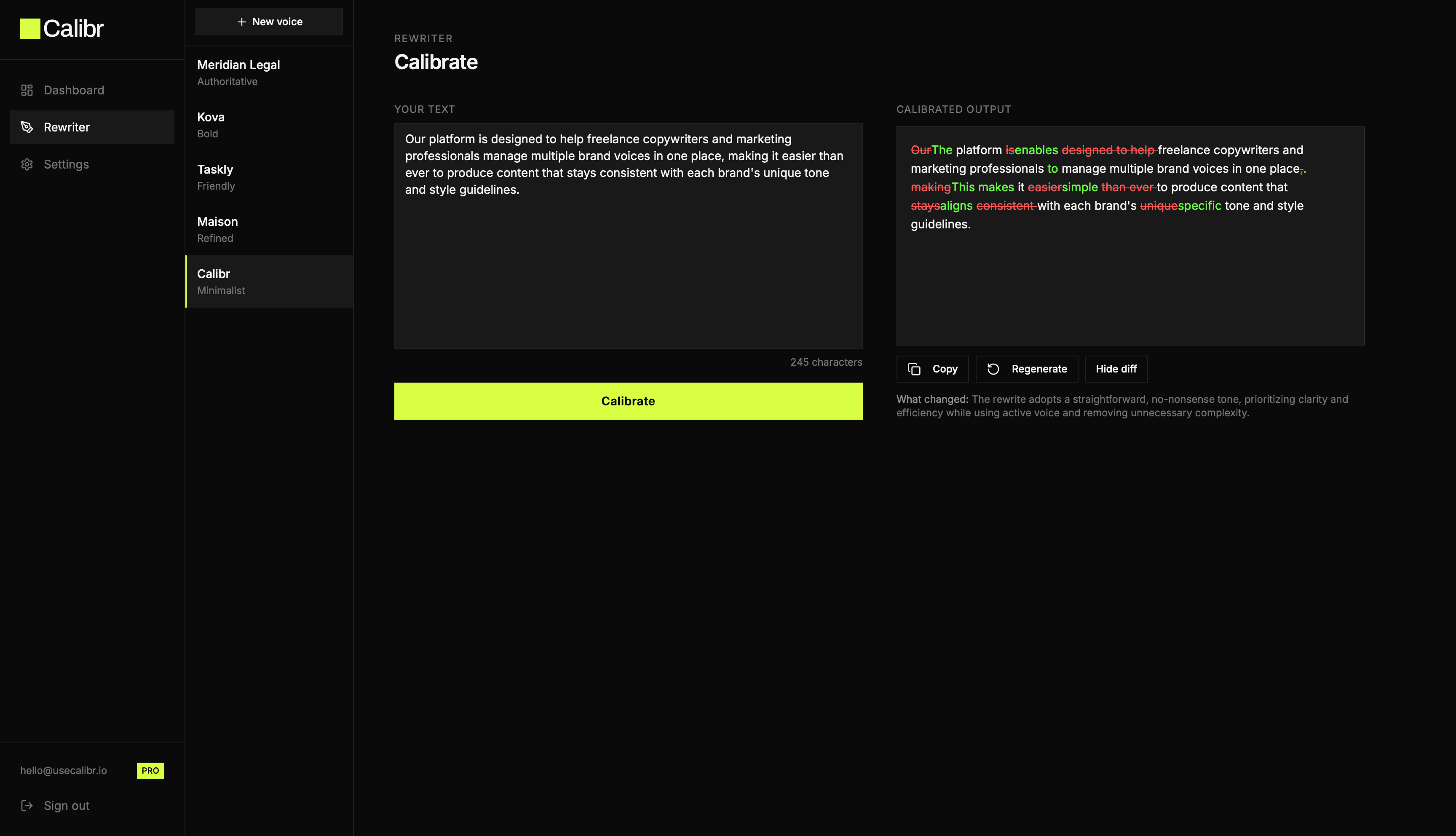
If you do this exercise every time a new client signs, you are doing the manual version of what a brand voice tool does automatically. Calibr lets you save the profile once and apply it to every draft after — no more recreating the wheel for the same client three weeks later when you switch from blog posts to email. Our post on writing brand voice guidelines your team will actually follow goes deeper on the documentation side once you have the raw inputs.
Building the one-page brand voice doc you will actually reference
A 30-page brand book gets read once and forgotten. A one-pager gets opened before every draft. You want the one-pager.
Structure it like this, on a single page:
Voice in three adjectives. Earned, not picked.
One sentence: "We sound like a [profession] who [verb] for [audience]." Forces concreteness.
Five "do" examples. Real sentences pulled from their existing copy.
Five "don't" examples. Real sentences rewritten in a generic professional voice for contrast.
Distinctive vocabulary list. 10-15 words or phrases this brand uses.
Forbidden words list. 10-15 words this brand never uses.
One sample paragraph in their voice. You write it. It becomes the calibration reference for every future draft.
That is the entire doc. One page. The client can read it in two minutes and know whether you got them right.
How to test the profile before you use it on paying work
Before the first paid deliverable, send the client a 100-word test. Pick a low-stakes topic they would plausibly publish — a LinkedIn post, an FAQ answer, a product description. Write it in the voice you just defined.
Send it with one line: "Before I start the real work — does this sound like you?"
If they say yes, you are calibrated. If they say no, the next message back tells you exactly what's off. That feedback is worth more than another hour of discovery, and it surfaces voice misalignment before it shows up in a deliverable they are paying for.
The handoff — turning your profile into a workflow
The mistake most copywriters make at this stage is treating the brand voice doc as a finished artifact. It is not. It is an input.
Every time you write for this client, the doc should be open or pinned. Every time the client gives feedback that adjusts the voice, update the doc the same day. After three to five deliverables, the doc stabilizes. After that, you can hand it to a junior writer, a VA, or an AI tool and get usable output without the original onboarding context.
This is also when freelancers and agencies start running into the multi-client version of the problem. One profile is manageable in a Google Doc. Five profiles across five clients turn into a stack of tabs you stop opening. Six and up requires a real system.
SOUND LIKE YOURSELF. EVERY TIME.
Calibr rewrites any text to match your saved brand voice in seconds.
★★★★★ No credit card required
Benefits
Everything your brand voice needs
Instant rewrite
Under 10 seconds from paste to calibrated output
Precise voice matching
Trained on your actual copy, not generic prompts
Multiple profiles
Separate voice for every client or brand
Rewrite history
Every calibration saved and accessible
Regenerate
Not happy with the output? One click to try again
What changed
Plain English summary of every adjustment made
Conclusion
A new client's brand voice is not a mystery you have to solve. It is a pattern in their existing writing that you extract with the right questions and the right reading method.
Do it in under an hour. Use a one-page doc. Test before you ship. And as soon as you have more than two or three clients on the go, stop trying to hold all the voices in your head — that is a workflow problem, not a talent problem.
Build the profile once. Rewrite anything in seconds. Calibr is free to try, no credit card required →
How it works
How Calibr works
Step 1
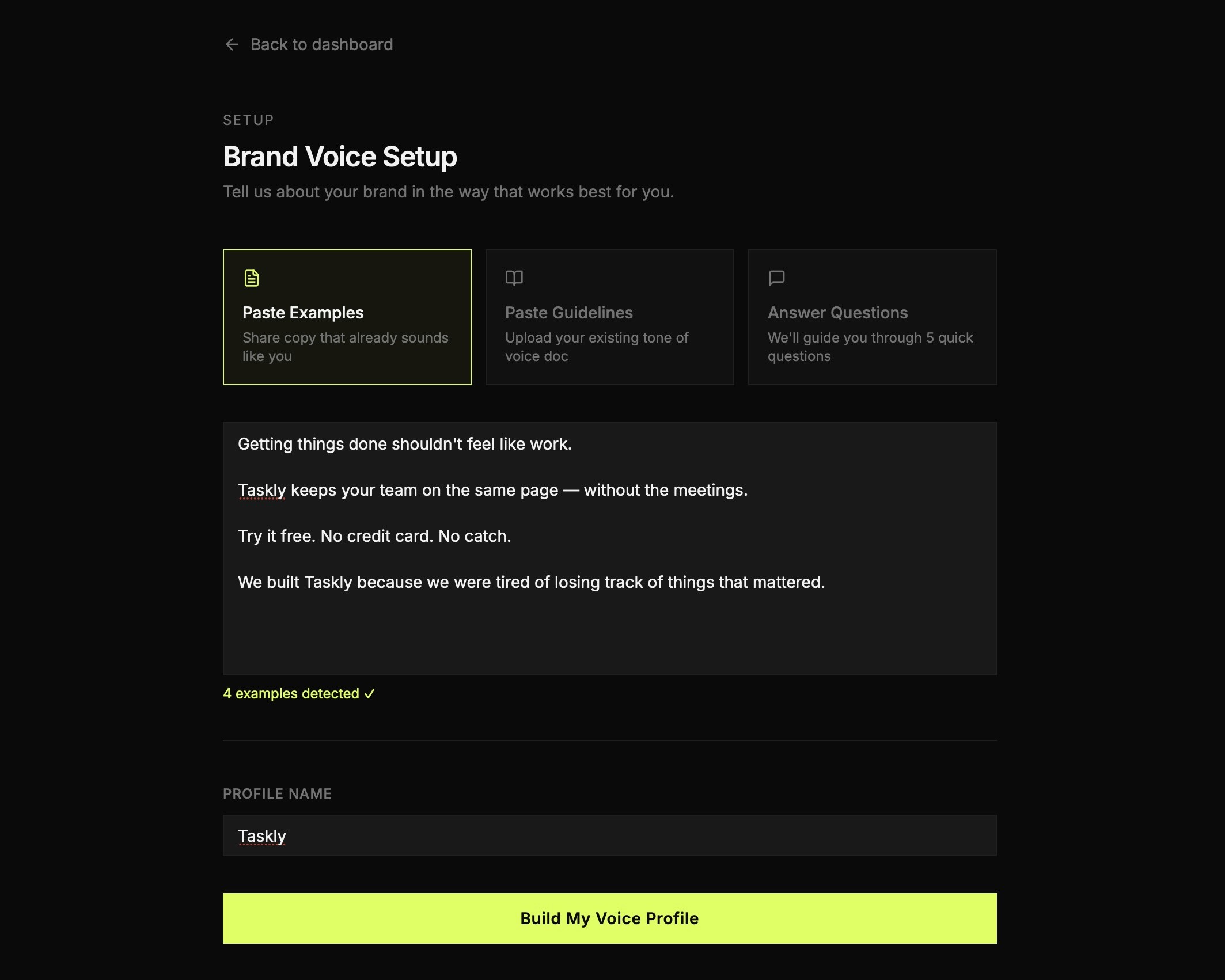
Build your voice
Paste examples, upload guidelines, or answer five questions. Done in minutes.
Step 2
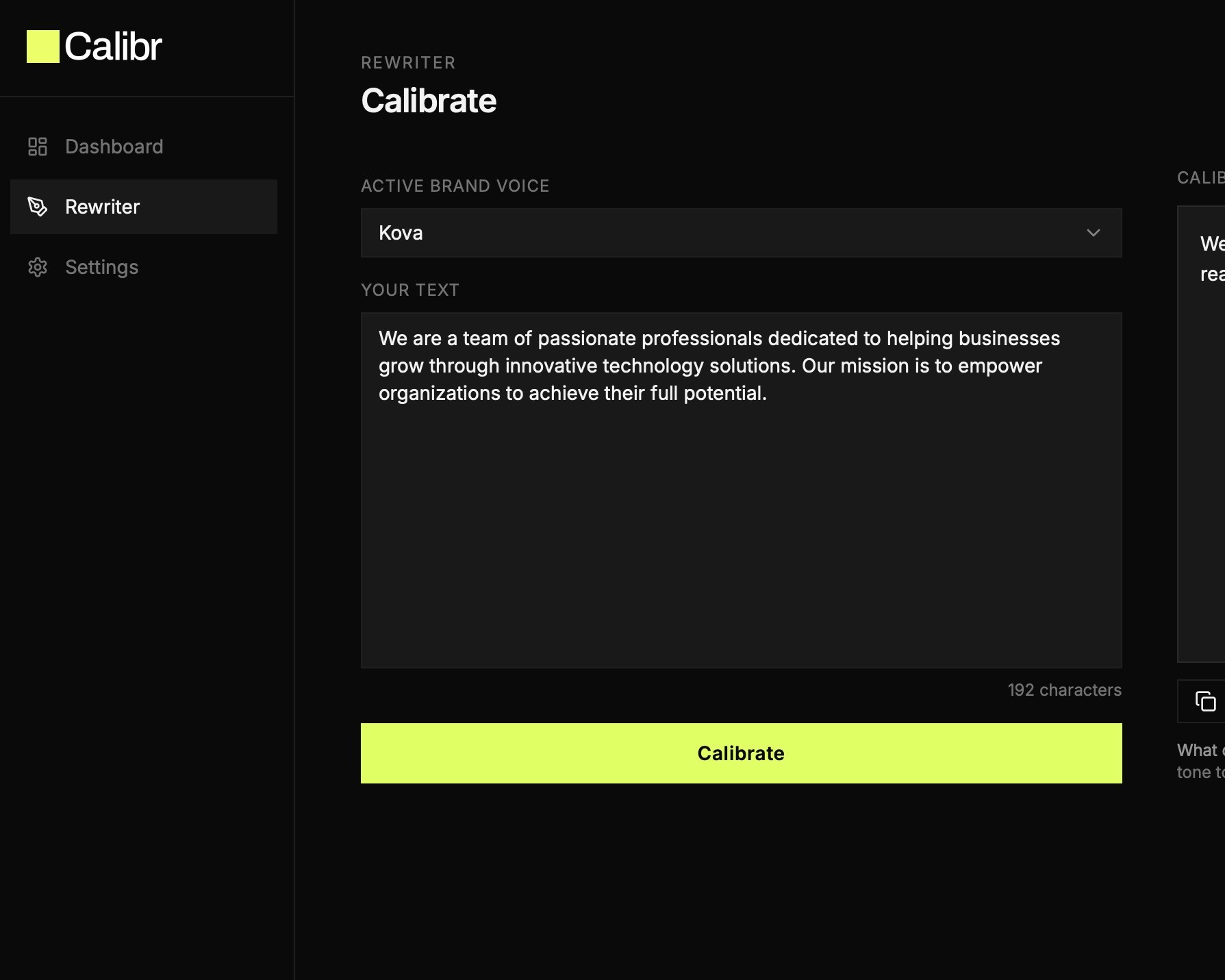
Paste any text
AI output, a draft, vendor copy, anything that needs to sound like your brand.
Step 3
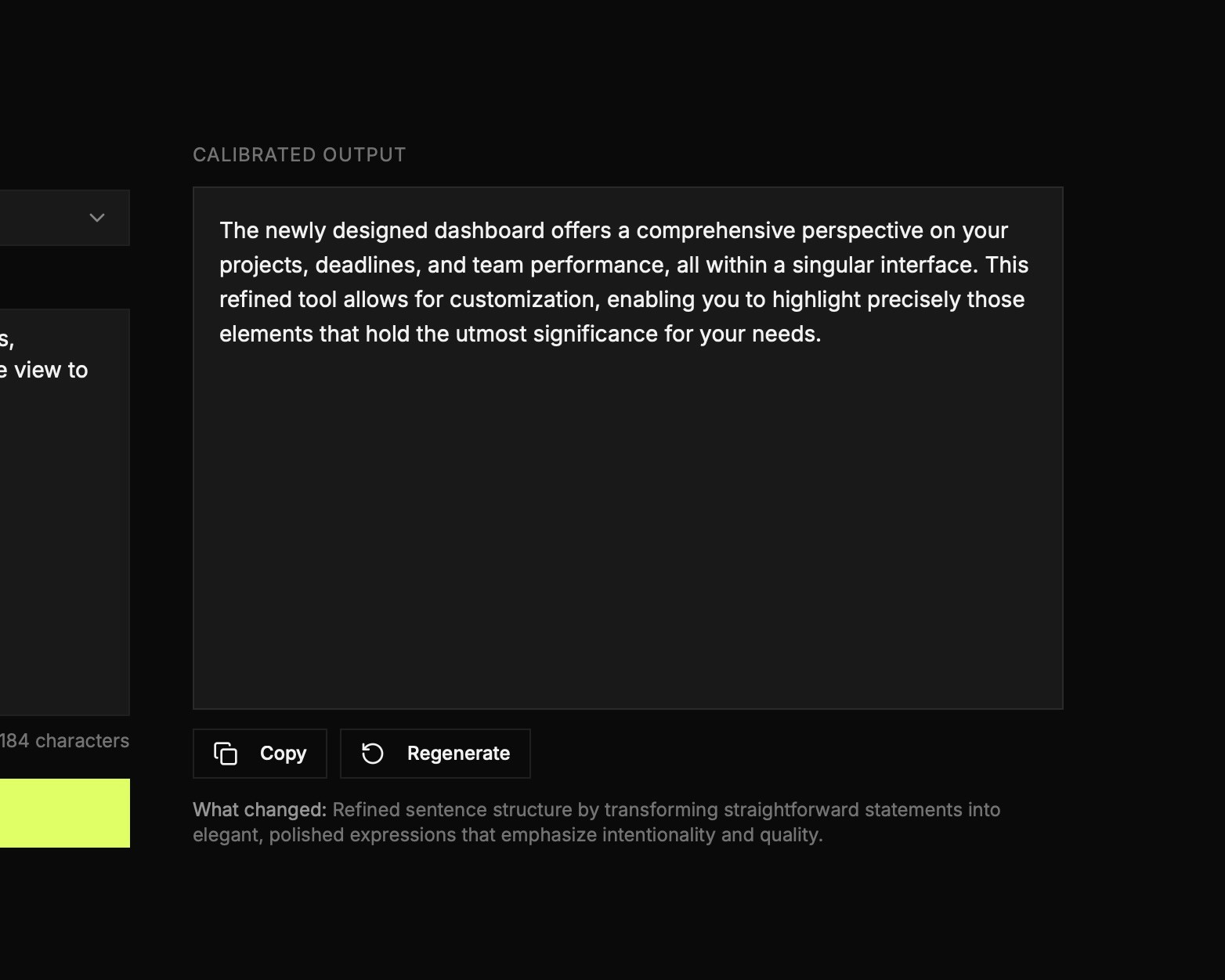
Get calibrated copy
Your text, rewritten in your voice. Copy it and ship it.
Frequently Asked Questions (FAQ)
How long should it take to onboard a new client's brand voice?
For a single brand without a complex internal stakeholder structure, under an hour is realistic and repeatable. That includes a 25-minute intake call, 20 minutes reading their existing copy, 10 minutes writing a one-page brand voice doc, and 5 minutes sending a test draft for confirmation.
What if my client doesn't have any existing brand voice guidelines?
This is the norm, not the exception. The fastest way to onboard a client's brand voice when no guidelines exist is to work backward from their published copy. Three to five real pieces — a landing page, a customer email, a recent social post — give you enough pattern to extract voice from. Skip the discovery workshop and read what they have shipped.
How do you onboard a client's brand voice when the founder writes everything themselves?
This is actually easier, not harder. Founder-written copy is usually the clearest expression of the brand voice. Get five samples from the founder specifically, not from the marketing team. Use the founder's writing as the reference voice and explicitly note that in the one-page brand voice doc.
Should I charge for brand voice onboarding as a separate engagement?
Yes — and most freelancers undercharge for it. A repeatable hour-long process that produces a one-page brand voice doc the client can use forever is worth a flat fee of $300-800 depending on your rates and the client size. Bundling it for free inside a content retainer trains clients to undervalue voice work.
What's the fastest way to onboard a client's brand voice if you're managing five or more brands?
Standardize the intake process and store each profile in a tool that lets you apply the voice automatically to new drafts. Holding five distinct brand voices in your head while writing accurately for all of them is a recipe for drift. A saved profile per client — whether in a structured doc or a dedicated tool — is the only system that holds up past three or four active retainers.